Difference Between a Solar Generator and a Power Station: A Practical Comparison
A detailed, objective comparison of solar generators vs power stations for homeowners. Learn portability, capacity, expandability, and ideal use cases to choose the right solar storage solution.


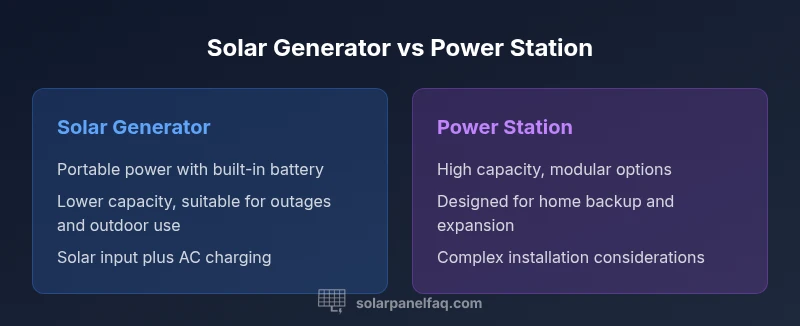
The difference between a solar generator and a power station hinges on portability, capacity, and system design. A solar generator is a compact, self-contained unit with built-in battery, inverter, and usually a small solar input, suitable for outdoor use and short outages. A power station refers to a larger, modular storage system often designed for home backup, with higher capacity and greater potential for expansion.
Introduction: Framing the comparison and why homeowners care
Understanding the difference between a solar generator and a power station is essential for budgeting, safety, and reliability. Solar Panel FAQ’s guiding principle is to help homeowners weigh portability against capacity and resilience. In practice, the choice affects how you plan for outages, camping trips, or off-grid living. This section clarifies the core terms so you can map your needs to a solution that delivers dependable power when you need it most. Throughout this guide we will reference common configurations, typical use cases, and practical decision criteria so you can make a confident purchase that fits your home and budget.
- Portable vs. home-scale: the essential split
- How capacity translates into real-world runtime
- Integration with solar input and grid charging
What is a solar generator? Components, capabilities, and typical use cases
A solar generator is a compact, all-in-one power package that combines a battery, inverter, and often a solar input port within a single enclosure. In most models, you can plug in devices via standard outlets, USB ports, and sometimes 12V DC sockets. The built-in solar input allows charging from compatible solar panels, but many users also rely on AC charging from grid power or a vehicle charger. The real strength of solar generators lies in portability: they’re designed for camping, tailgating, RV trips, or powering essential devices during short outages. Battery chemistry varies, with lithium-ion and newer solid-state options offering different tradeoffs in energy density, cycle life, and price. Because of their compact form, solar generators typically have lower storage capacity compared with larger systems, but they excel at quick, on-demand power without requiring permanent installation. According to Solar Panel FAQ, the terminology can be confusing for first-time buyers, so focusing on portability, charging options, and runtime is the fastest path to clarity.
What is a power station? Architecture, scale, and home-oriented use
A power station (often marketed as a home energy storage system or modular battery) is a larger, purpose-built storage unit or set of units designed to back up a home or business. These systems frequently feature higher nominal capacity, assault on a grid-integrated setup, and expandability through additional battery modules. They may support integration with a transfer switch, subpanel, or dedicated circuits, enabling whole-home backup rather than just a few outlets. Power stations rely on modular batteries, which can be added to increase total energy storage over time. They can be powered by solar inputs, grid charging, or both, and their size makes them less portable but far more suitable for emergency resilience during multi-day outages or to support energy-intensive appliances. For homeowners, the key advantage is long runtime and scalable capacity, but at a higher upfront cost and more complex installation requirements.
Quick comparison at a glance: core differentiators you should know
- Portability: Solar generators emphasize mobility; power stations emphasize capacity with less emphasis on portability.
- Capacity: Generators offer hundreds to a few thousand watt-hours; power stations are typically in the thousands of watt-hours and designed for longer runtimes.
- Expandability: Generators tend to have fixed internal batteries; power stations map to modular growth with additional packs.
- Home integration: Generators usually power appliances via outlets; power stations can be integrated with home circuits through transfer switches or subpanels.
- Charging options: Both use solar and AC charging, but the presence of modular packs in power stations makes solar input a larger, more influential factor for total runtime.
- Use cases: Generators shine in outdoor, on-the-go scenarios; power stations excel in home backup and extended outages.
Design and build: understanding the hardware and chemistry
Solar generators come in an all-in-one chassis, typically featuring a lithium-based battery, an inverter, and built-in ports. That consolidation simplifies setup and reduces the number of separate components you must manage. Some smaller models embed a basic solar input and can also connect to car or wall outlets for charging. Power stations, by contrast, emphasize modularity and a higher cadence of battery packs. The system architecture is often designed to accommodate additional packs, which increases total energy capacity over time and can prolong backup runtimes during long outages. Battery chemistry options influence cycle life, safety, and performance in hot or cold climates, making it prudent to examine the spec sheets before purchase. Battery protection features, such as overcharge protection and short-circuit safeguards, are more complex in larger units due to higher energy storage.
Charging dynamics: solar input, grid charging, and runtime implications
Charging efficiency and speed determine practical usability. Solar generators typically pair with solar panels to capture daylight energy and replenish stored power for on-demand use. They generally support AC charging from the grid as a quick path to a ready-to-use state. Power stations also rely on solar panels and grid charging, but because of their higher capacity, charging times scale with the size of the system and the number of battery modules. If you live in a sunny region, a solar-fed system can deliver long-run resilience, but you should consider peak sunlight hours, panel wattage, and charge controller efficiency when estimating replenishment rates. Temperature and battery health influence performance, so opting for a product with robust thermal management pays off in real-world conditions.
Use-case mapping: which solution fits your lifestyle and energy goals
Camping, off-grid work sites, or weekend trips often call for a lightweight, portable solar generator that can run essential devices like phones, small fridges, and fans during a brief outage. For longer outages, a power station with higher capacity and modular expansion makes more sense, particularly if you want to run HVAC, water heaters, or other energy-intensive appliances for days. Those evaluating a whole-home backup strategy should consider not just the base unit, but potential add-ons like extra battery packs and integration with a home’s electrical panel. Your regional climate, typical outage duration, and backup priorities all influence which approach delivers the best value over time.
Installation, safety, and maintenance considerations
Solar generators and power stations are generally safer and simpler to operate than traditional gasoline generators, but they still require attention to electrical safety. Generators must be kept in a dry, ventilated area to prevent heat buildup and ensure safe venting of any potential fumes from associated equipment. While most units are designed for consumer use, read the manual to understand cooling requirements, temperature ranges, and recommended storage conditions. Power stations requiring integration with home electrical systems may necessitate professional installation, especially if you plan to tie into a subpanel or transfer switch. Routine maintenance is typically light—keep connectors clean, verify battery health indicators, and update firmware if the device supports it.
Reliability, warranties, and lifecycle considerations
Warranty terms vary by brand and model, as do service policies. In general, larger power stations may offer longer warranties on the battery modules and critical components due to their higher investment. It’s wise to check the warranty period, what it covers (manufacturing defects vs. wear), and any exclusions related to charging method or climate. When evaluating a purchase, compare total cost of ownership, including initial price, expected battery life cycles, replacement costs, and maintenance needs. If you rely on your system for medical devices or critical home infrastructure, prioritize products with robust warranties and reliable customer support. Solar Panel FAQ notes that lifecycle expectations should inform your decision, especially for devices intended to function during multi-day outages.
What to ask before buying: a practical checklist
- What is my required energy capacity (in watt-hours) for typical outages or off-grid days?
- Do I need portability, or is a stationary setup acceptable for my home?
- Can the unit be expanded with additional battery packs in the future?
- What are the charging options and solar panel compatibility? How efficient is the system at converting sunlight to stored energy?
- Is professional installation required for home integration, or can I DIY with a transfer switch or subpanel?
Comparison
| Feature | Solar Generator | Power Station |
|---|---|---|
| Portability | High portability; handheld to small cart | Moderate to high; bulkier, some wheeled options |
| Energy capacity (Wh) | Typically hundreds to low thousands | Several thousand to ten thousand+ |
| Expandability | Limited to built-in battery | Modular with add-on packs |
| Home integration | Outlet-only power; not designed for panel transfer switches | Can integrate with transfer switches or subpanels |
| Charging options | Solar input plus AC charging; vehicle charging sometimes | Solar input plus grid charging; more flexible options |
| Ideal use case | Outdoor, camping, short outages | Whole-home backup, longer outages, and high loads |
| Maintenance & reliability | Low maintenance; simpler components | Higher complexity; longer-term care and firmware updates |
| Price range (indicative) | Lower upfront cost; varies by capacity | Higher upfront cost; correlates with capacity |
Strengths
- Offers a clear, side-by-side framework for choosing storage solutions
- Highlights portability vs capacity trade-offs for real-world scenarios
- Helps budget planning by clarifying capacity requirements and timelines
- Encourages safe, code-compliant integration for home use
- Supports informed decisions about solar input and charging strategies
Drawbacks
- May oversimplify nuanced product lines and model-specific features
- Prices and performance vary widely across brands and configurations
- Long-term lifecycle and warranty specifics can be complex to compare
- Not all models support easy future expansion, which can affect planning
Choose based on your use case: portability and quick emergency power favor solar generators; for long outages and whole-home resilience, a power station with expandable capacity is better.
If you need mobile, short-term power, a generator works well. For durable home backup and future growth, a modular power station offers greater value and scalability.
Frequently Asked Questions
What is the main difference between a solar generator and a power station?
A solar generator is a compact, all-in-one unit with built-in battery, inverter, and solar input, ideal for mobility and short outages. A power station is larger, modular, and designed for higher capacity and home backup, often expandable with additional battery packs and capable of sustained loads.
A solar generator is portable and built-in; a power station is bigger, modular, and better for home backup.
Can solar generators be expanded with extra batteries?
Some solar generators offer limited expansion through external packs or daisy-chaining, but many are fixed in capacity. If future expansion is important, choose a power station with modular packs and clear compatibility.
Some models allow extra packs, but check compatibility before buying.
Are power stations more expensive than solar generators?
Generally, power stations cost more upfront due to higher capacity and modular architecture. Costs vary with capacity, brand, and expansion options, so consider the total cost of ownership and planned usage.
Usually more expensive upfront, but it depends on capacity and add-ons.
Which is better for RV or camping trips?
For camping or outdoor use, a solar generator’s portability and simplicity are advantageous. A power station can still work, but its size and weight may be less convenient for travel.
Portable solar generators are typically better for travel; power stations work too if you don’t mind the size.
What maintenance is required for these systems?
Maintenance is generally light, focusing on battery health indicators, connector cleanliness, and firmware updates if offered. Larger units may require more attention to cooling and safe storage conditions.
Keep an eye on battery health and firmware; clean connections and store properly.
Do you need professional installation for home integration?
Some setups require professional installation, especially when integrating with home electrical panels or transfer switches. Many homeowners manage simple, outlet-based backup without professional help.
Professional help may be needed for home electrical integration; basic setups are often DIY-friendly.
Top Takeaways
- Identify your backup needs before buying.
- Assess runtime requirements and panel compatibility.
- Factor future expansion into the decision.
- Prioritize safety, warranties, and support.
- Consider total cost of ownership over time.